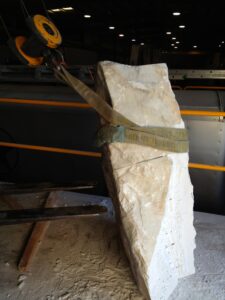
When Otter returned to the United States, he brought this block of marble with him.
This block of marble had been selected in Italy — cut from the same mountains of Carrara where Michelangelo took his marble. It carried not only weight, but memory. Otter did not leave Italy behind when he came home; he carried the culture with him not just materially, but physically, and mentally.
At this point, Otter held an Associate in Fine Arts. When he returned state side, he received immediate acceptance into one of the last classical art University's in the United States to receive his Bachelors in Fine Arts.
Otter’s first semester back was stripped down to essentials. No electives. No distractions.
The faculty knew he had the sculptural process. What they wanted him to master was anatomy — total immersion. He was placed in a graduate-level studio immediately and given an accelerated anatomical education. Otter studied anatomy obsessively, then turned around and helped teach it. Professors would teach a lesson one day, and Otter would be on the floor teaching the same material the next.
At the same time, he ran the bronze foundry.
Otter handled all of the pours for the sculpture department, aligning the process with Renaissance traditions. He learned bronze not as a supplement, but as a responsibility. His days were divided between anatomy, metal, and stone — a classical workload, a classical education.
Otter knew anatomy on the surface — muscle groups, proportions, landmarks. What he lacked was what lived underneath.
The Professors modeled this semester for that reason.
He studied cadavers. He learned the origins and insertions of almost every muscle in the body, how one movement causes another. He wanted to understand not just what the body looks like, but why it behaves the way it does. He knew that once he understood the interior, he could sculpt from the inside out.
Otter made it clear to the university that he wanted to go far beyond what he had learned during his Associate degree. He wanted to reach the level where a doctor could stand in front of his sculpture and recognize that he understood what was happening beneath the skin.
This, he knew, was what took Michelangelo’s work to a level not seen for centuries during the Italian High Renaissance.
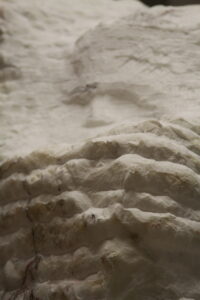
When Otter finally brought the marble into the graduate studio, He remembered what he had been taught in the mountains of Italy.
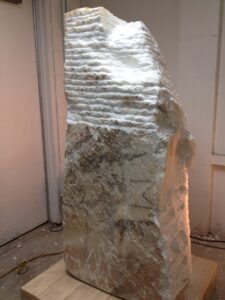
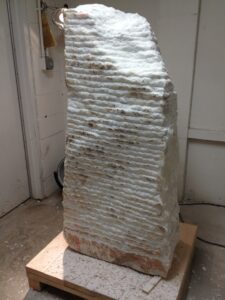
Using a one-point chisel (Called a subia), he intuitively sculpted straight lines across the surface of the entire stone — in order to unite, understand, and be able to communicate with it. Not as measurements, but as a way to feel the marble. These lines told him where the stone wanted to go. They mapped resistance. They clarified intention.
What became immediately clear was something Otter had avoided in Italy.
The face.
The lines made it obvious that the face was the first thing that needed to be attacked — not avoided.
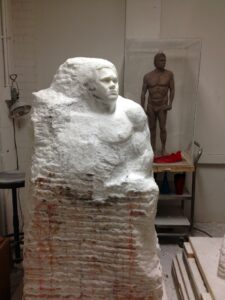
In Italy, the face had terrified him.
Here, Otter did the opposite.
He attacked it first.
He knew the last time he faced it, it set him on fire. This time, he did not wait. He sculpted the face immediately and then moved everything else back like water flowing around a stone. The decision changed the entire sculpture.
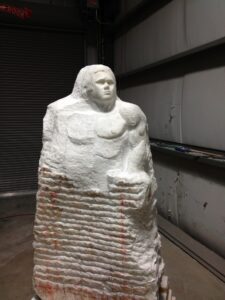
Once the face was established, the rest of the sculpture followed naturally. Anatomy guided every decision. Otter could now see what was happening beneath the surface before it appeared above it.
At a certain point, the studio became too exposed. Too many people were stopping to look. The university became concerned that someone might accidentally damage the marble.
They moved the sculpture to a nearby warehouse.
There, Otter worked alone. Buckets of broken marble piled up so quickly they began to get in the way. Faculty would stop by periodically to check his progress, but otherwise left him to work.
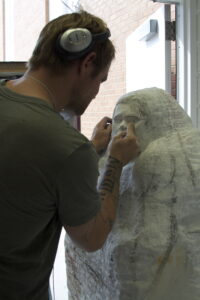
As Otter continued pushing the sculpture back, something became clear.
This figure was going to stand on two feet.
No sculpture had done that before.
Otter was moving more marble than he had on his first sculpture — entirely by hand — while simultaneously running the foundry, studying anatomy, teaching classes, and working day to night. This was all accomplished in a single semester.
He worked every day, from morning until night.
By the end, the university had seen what it needed to see. Otter had accomplished what he set out to do with this block.
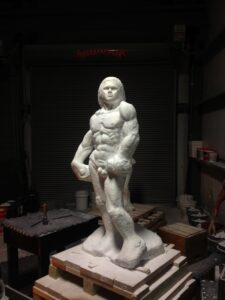
This is the sculpture as it stands today.
Unfinished — but resolved.
The body and legs are largely complete. The figure stands on its own two feet. There is still marble at the base, still work that could be done, but the purpose of the piece had been fulfilled.
On the final day Otter worked on this sculpture, he received news that a close friend had passed away.
He dropped his tools.
In that moment, he knew he was finished — not because the sculpture was complete, but because it had taken him where he needed to go. All he could think about was another David that he saw in his head — a figure that could stand on its own, fully independent, undeniable.
That loss ignited something.
Otter understood that time was not guaranteed. He wanted to create something that would endure — something that could stand on its own and speak in his absence. He had learned the fundamentals. He had mastered anatomy. Now it was time to move forward — unconventionally.
After this, the university took Otter off the leash.
They told him he would no longer be taking classes.
The Professors told him to focus entirely on what he saw in his head.
This was the beginning of Otter distinguishing himself and his own identity as an artist. When people see his sculpture, they should see him. They should respond to it in a meaningful way.
This shift changed everything — even his painting.
Otter does not paint like a painter.
He paints like a sculptor.
This was the start of Otter's Unconventional Artistic Future.
Effective upon entry to this website
By accessing this website, you acknowledge and agree that all content displayed on Otter’s Renaissance — including but not limited to images, sculptures, artwork, designs, text, logos, and original concepts — are the exclusive intellectual property of Stephen “Otter” Otten, unless otherwise stated.
All artwork and content on this site is protected under United States and international copyright, trademark, and intellectual property laws.
You agree not to copy, download, reproduce, distribute, modify, display, publish, transmit, create derivative works from, or otherwise use any content or imagery from this website for commercial or non-commercial purposes without prior written consent from the artist.
You further agree not to use automated tools, scraping software, bots, or manual processes to extract images or content from this website.
Unauthorized use, reproduction, or distribution of any artwork or content may result in legal action.
By clicking “I Agree”, you acknowledge that you have read, understood, and agreed to these TERMS OF SERVICE as well as the COPYRIGHT AND USE AGREEMENT.